|
|
|
Kutch
|
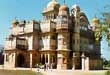
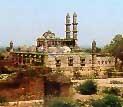
For centuries Kutch was isolated from its neighbours, making for a distinct history and a unique culture. It was the only kingdom that never paid a penny of tribute to the British, nor even suffered the presence of a resident. The capital, Bhuj, is a walled city containing the lake Darbar Gadh (City Palace), situated near a lake, replete with a marble watch-tower and sprawling labyrinthine residential quarters. It also houses the Aina Mahal Museum. A short drive away brings one to the jewel of Kutch, Vijay Vilas Palace, set at the private white sanded beach of Mandvi, where on request, one may overnight at the Guest House. Proceed to Banni , which feeds this desert state's cattle particularly in times of drought. Onward to village Dordha, the home of Mia Gulbeg, the chief of several villages engaged in the fabrication of local textiles. Apart from Banni, Kutch encompasses the Graeter and Lesser Ranns which are similar to the Utah Salt Flats. The Ranns are the best nesting grounds in the world of the flamingo and the near extinct Painted Stork, not forgetting that it is the only habitat for the Inian Wild Ass. From here, on to His Highness the Nawab's Camp Zainabad, on the fringe of the Lesser Rann, to view nature in regal comfort. |
|
|
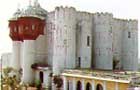
Situated 72 kms by road from Jodhpur, the feudal Gadh of Khejarla with its whitewashed walls and 'jerukhas' of red sandstone is a striking landmark that can be seen a great distance off before one comes to the village. Built on the asme lines as Meherangadh Fort of Jodhpur, it was this very fact which was the bone of contention between the Maharajah of Jodhpur and the then Thakur of Khejarla, until suitable modifications of design were effected. Sights worth seeing in the vicinity of the Gadh are the family shrine, dating to the period of Emperor Harshvardhan, situated precariously atop a boulder-strewn hill; a subterranean cave, once the dwelling of an ascetic, now venerated as a place of pilgrimage; the cenotaphs - 'Chhatris' in common parlance - of the Thakurs and their families. A traditional royal welcome awaits visitors who are greeted by Thakur Durga Das. Accomodation is a choice of the 'Bhurj' (a bastion room) or one of the many guest rooms decorated with hunting trophies and prints. |
|
|
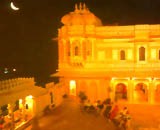
A
castle of medieval rajasthan, the Deogarh Mahal has been witness to history
unfolding within and beyond its realms. Built in 1670 A.D. by Rawat Dwarka
Dasji as a family residence, it soon became the hub of village activity.
The family interacted with the villagers and invited a host of feasts and
festivities to be performed within the Mahal precints. Some of these traditions
are still upheld. The Mahal stands at a height of 2100 ft above sea level
and is cooler than surrounding Rajasthan. With its bold battlements, domed
turrets and balconies, the Mahal towers over the town below. The imposing
gateways once closed to ward off enemies are now thrown open by the family
in a gesture of welcome.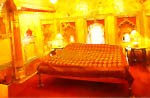 One of the elegant suites... |