| |
 |
| |
|
|
|
CCNP |
| ( CISCO Certified Network Programme ) |
| |
The CCNP certification (Cisco Certified Network Professional) indicates advanced or journeyman knowledge of networks. With a CCNP, a network professional can install, configure, and operate LAN,WAN, and dial access services for organizations with networks from 100 to more than 500 nodes, including but not limited to these protocols: IP, IGRP, IPX, Async Routing, AppleTalk, Extended Access Lists, IP RIP, Route Redistribution, RIP, Route Summarization, OSPF, VLSM, BGP, Serial, Frame Relay, ISDN, ISL, X.25, DDR, PSTN, PPP, VLANs, Ethernet, Access Lists, 802.10, FDDI, Transparent and Translational Bridging.
Organizations whose networks have from 100 to more than 500 nodes. |
| |
| A CCNP certified individual can perform the following tasks: |
| |
~
~
~
~
~
|
Implement appropriate technologies to build a scalable routed network
Build campus networks using multilayer switching technologies
Improve traffic flow, reliability, redundancy, and performance for campus LANs, routed and switched WANs, and remote access networks
Create and deploy a global intranet
Troubleshoot an environment that uses Cisco routers and switches for multiprotocol client hosts and services |
| |
| Positions for a CCNP certified individual include: |
|
| |
~
~
~
~
~ |
Network administrator.
Level 2 support engineer
Level 2 systems engineer
Network technician
Deployment engineer
|
| |
| Advance Your Career CCNP Certification |
| |
|
Expand Your Professional Options Gaining and Certifying Advanced Skills
The CCNP certification validates an individual’s networking skills at the midcareer level. Candidates who pass the required proctored exams will receive a CCNP certificate from Cisco and may use the CCNP designation on their business cards.
CCNP forms the professional level of the Cisco Career Certification program. |
| |
| Who is the course for? |
| |
| Anyone with a good background in Computer Networks and the Internet and preferably CCNA qualified. |
| |
| What will the course give you? |
| |
~
~
~
~
~ |
Preparation for the CISCO Certified Network Professional Exams
Advanced networking skills to design, install and maintain large routed computer networks.
Increased professional credibility by gaining high standards of technical expertise.
Skills necessary to improve your opportunities within the workforce.
The knowledge and skills necessary to take the CCNP exams
|
| |
| What material is covered ? |
|
| |
~
~
~
~
~
~
~
~
~
~
~ |
Extending IP Addresses Using VLSMs
Configuring OFPF, Enhanced IGRP and BGP
Assembling and Cabling WAN Components
Using ISDN and DDR to Enhance Remote Connectivity
Scaling IP Addresses with PAT and NAT
Introduction to Switching Concepts and Virtual LANs
Support Resources for Troubleshooting
Workgroup Discovery Lab and CCO
Documenting Symptoms, Actions and Results
Tracking Log-ins and Connections
Troubleshooting VLANs on Routers and Switches
|
| |
|
| |
| Required Exam(s) |
Recommended Training |
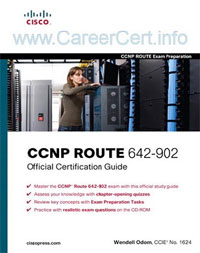
| 642-902 ROUTE |
Implementing Cisco IP Routing |
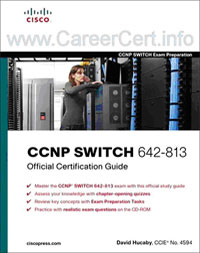
| 642-813 SWITCH |
Implementing Cisco IP Switched Networks |
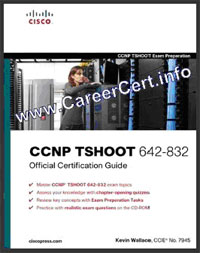
| 642-832 TSHOOT |
Troubleshooting and Maintaining Cisco IP Networks |
|
| |
| Building Scalable Cisco Internetworks Exam (BSCI)(642-801) |
| |
| The Building Scalable Cisco Internetworks exam is one exam within a series of exams required to achieve CCIP certification. This exam will also be accepted as a replacement for the Routing exam (640-603 RTING), since the content includes all topics for the Routing exam as well as additional information relevant to communications and services audiences. |
| |
| Exam Topics |
| |
| The following topics are general guidelines for the content likely to be included on the Building Scalable Cisco Internetworks exam. However, other related topics may also appear on any specific delivery of the exam. |
| |
~
~
~
~
~
~
~
~
~
~
~
~
~
~
~
~
~
|
List the key information routers needs to route data
Describe classful and classless routing protocols
Describe link-state router protocol operation
Compare classful and classless routing protocols
Compare distance vector and link state routing protocols
Describe concepts relating to extending IP addresses and the use of VLSMs to extend IP addresses
Describe the features and operation of EIGRP
Describe the features and operation of single area OSPF
Describe the features and operation of multi-area OSPF
Explain basic OSI terminology and network layer protocols used in OSI
Identify similarities and differences between Integrated IS-IS and OSPF
List the types of IS-IS routers and their role in IS-IS area design
Describe the hierarchical structure of IS-IS areas
Describe the concept of establishing adjacencies
Describe the features and operation of BGP
Explain how BGP policy-based routing functions within an autonomous system
Explain the use of redistribution between BGP and Interior Gateway Protocols (IGPs) |
| |
| Building Cisco Multilayer Switched Networks (BCMSN)(642-811) |
| |
| In the Building Cisco Multilayer Switched Networks (BCMSN) course, network administrators learn how to build campus networks using multilayer switching technologies over high speed Ethernet. This course includes both routing and switching concepts, covering both Layer 2 and Layer 3 technologies. BCMSN is part of the recommended training path for those students seeking the Cisco Certified Network Professional (CCNP), Cisco Certified Design Professional (CCDP), and Cisco Certified Internetwork Expert (CCIE) certifications. |
| |
Exam Topics
The following topics are covered in the BCMSN course:
|
| ~ |
Describe the Enterprise Composite Model used for designing networks and explain |
| |
how it addresses enterprise network needs for performance, scalability and |
| availability |
| ~ |
Describe the physical, data-link and network layer technologies used in a switched |
| |
network, and identify when to use each |
| ~ |
Explain the role of switches in the various modules of the Enterprise Composite |
| |
Model (Campus Infrastructure, Server Farm, Enterprise Edge, Network |
| Management) |
| ~ |
Explain the function of the Switching Database Manager [specifically Content |
| |
Addressable Memory (CAM) and Ternary Content Addressable Memory (TCAM)] |
| within a Catalyst switch |
| ~ |
Describe the features and operation of VLANs on a switched network |
| ~ |
Describe the features of the VLAN trunking protocols including 802.1Q, ISL |
| |
(emphasis on 802.1Q) and dynmic trunking protocol |
| ~ |
Describe the features and operation of 802.1Q Tunneling (802.1QinQ) within a |
| |
service provider network. |
| ~ |
Describe the operation and purpose of managed VLAN services |
| ~ |
Describe how VTP versions 1 and 2 operate including domains, modes, |
| |
advertisements, and pruning |
| ~ |
Explain the function of the Switching Database Manager [specifically Content |
| |
Addressable Memory (CAM) and Ternary Content Addressable Memory (TCAM)] |
| within a Catalyst switch |
| ~ |
Explain the operation and purpose of the Spanning-Tree Protocol (STP) on a |
| |
switched network |
| ~ |
Identify the specific types of Cisco route switch processors, and provide |
| |
implementation details |
| ~ |
List and describe the operation of the key components required to implement |
| |
interVLAN routing |
| ~ |
Explain the types of redundancy in a multilayer switched network including |
| |
hardware and software redundancy |
| ~ |
Explain how IP multicast operates on a multilayer switched network, including PIM, |
| |
CGMP and IGMP |
| ~ |
Describe the quality issues with voice traffic on a switched data network, including |
| |
jitter and delay |
| ~ |
Describe the QoS solutions that address voice quality issues |
| |
Describe the features and operation of network analysis modules on Catalyst |
| switches to improve network traffic management |
| ~ |
Describe Transparent LAN Services and how they are implemented in a service |
| |
provider network |
| |
| Building Cisco Remote Access Networks (BCRAN)(642-821) |
| |
| In the Building Cisco Remote Access Networks course, students learn how to build, configure and troubleshoot a remote access network to interconnect central sites to branch offices and home offices. Students also learn how to control access to the central site, as well as to maximize bandwidth utilization over the remote links. |
| |
Exam Topics
The following topics are covered in the BCRAN course: |
| |
| ~ |
Describe how different WAN technologies can be used to provide remote access to |
| |
a network, including asynchronous dial-in, Frame Relay, ISDN, cable modem, and |
| |
DSL |
| ~ |
Describe traffic control methods used to manage traffic flow on WAN links |
| ~ |
Explain the operation of remote network access control methods |
| ~ |
Identify PPP components, and explain the use of PPP as an access and |
| |
encapsulation method |
| ~ |
Describe the structure and operation of virtual private network technologies |
| ~ |
Describe the process of Network Address Translation (NAT) |
| ~ |
Configure asynchronous modems and router interfaces to provide network access |
| ~ |
Configure an ISDN solution for remote accessv |
| ~ |
Configure frame relay operation and traffic control on WAN links |
| ~ |
Configure access control to manage and limit remote access |
| ~ |
Configure DSL operation using Cisco IOS |
| ~ |
Configure Network Address Translation (NAT) |
| |
| Cisco Internetwork Troubleshooting (CIT)(642-831) |
| |
| The Cisco Internetwork Troubleshooting (CIT) course teaches students how to baseline and troubleshoot an environment using Cisco routers and switches for multiprotocol client hosts and servers connected with the following: |
| |
~
~ |
Ethernet and Fast Ethernet LANs
Serial, Frame Relay, and ISDN BRI WANs |
| |
| The course provides students with methodical practice using specific Cisco IOS software and Catalyst software tools to diagnose and correct problems on widely installed Cisco products. |
|
Exam Topics
The following topics are covered in the CIT course: |
| |
~
~
~
~
~
~
~ |
Identify troubleshooting methods.
Explain documentation standards and the requirements for document control.
Establish an optimal system baseline.
Diagram and document system topology.
Document end system configuration.
Verify connectivity at all layers.
Select an optimal troubleshooting approach. |
| |
|
| |
| The CISCO Certified Network Professional exam (CCNP) will have four papers. |
| |
| Course Fees does not include Examination Charges |
| |
|
| Examination Fees |
Per Paper US$ |
No. of Papers |
| CCNP |
150 |
3 |
|
| |
|













 +91-22-23676218 / 23671772